Painted Flats, Built Rooms and Flexible Stage Space
Compare painted flats, built rooms and flexible stage space to choose scenery that makes your production’s locations and dramatic action clear.
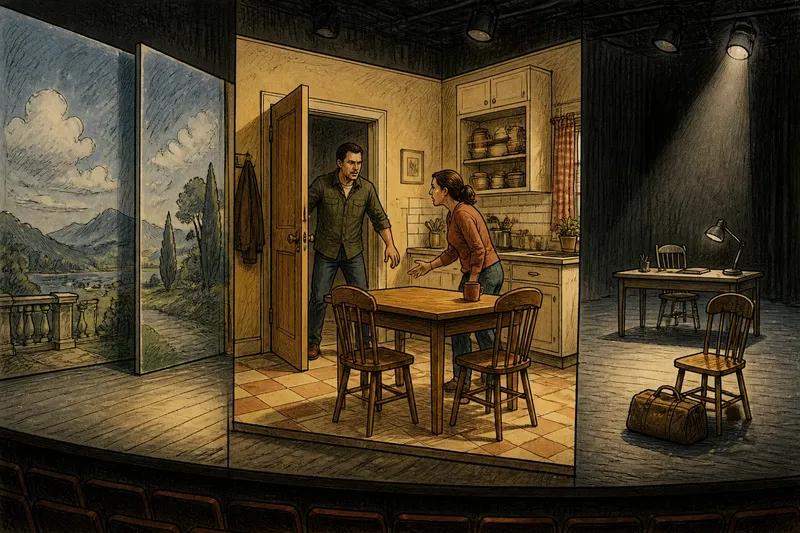
Painted flats, built rooms and flexible stage space each direct an audience’s attention differently. Choose between them by deciding what the scene needs viewers to recognise, and what actors need the space to let them do.
Painted scenery
A painted flat is an upright scenic panel that can suggest a wall, doorway or distant view. Arranged together, flats can create a composed stage picture and establish a location quickly.
Painted scenery is useful when the audience needs a clear visual setting, but it does not have to reproduce a complete room. A painted door can signal an entrance; a backdrop can set a scene without giving actors practical walls to touch or cross.
Perspective painting can make a stage image appear deep from some viewing positions and less convincing from others. Treat that as a design consideration: decide what the central image should be, then check whether viewers at the sides can still read the important details.
Built rooms
A built room gives actors practical boundaries and surfaces. Doors, windows and furniture can become part of the action: a character can hesitate at a threshold, take a place at a table or be prevented from leaving.
This approach suits scenes where privacy, social rules or confinement shape behaviour. A closed door can delay an entrance, while a table can separate people during a negotiation. Keep details that help the audience understand the setting or give performers something meaningful to use.
A detailed room also makes claims about its occupants and their circumstances. If the production’s action does not use those details, they can draw attention away from the scene. Build what the story needs rather than completing a room for its own sake.
Say you are staging an invented family argument in a kitchen. The starting point is a character trying to leave while another blocks the route. Put a practical doorway on that route and a table where it changes how the characters face each other; then rehearse the movement. If the audience can see the attempted exit and obstruction, those two pieces of scenery are doing useful work. If the table hides the action, move it or remove it.
Flexible stage space
Flexible stage space uses a small number of objects, lighting cues and changes in actor movement to suggest different locations. It suits stories that travel between places or shift viewpoint without pausing for a full scenery change.
Give each location a readable cue. A chair placed behind a desk may suggest an office; the same chair beside a travel bag may suggest a waiting area. The object is like a road sign: it helps the audience orient itself, but only if its meaning is clear in context.
Keep transitions visible and consistent. If an object changes meaning, let actors move it or establish the new arrangement before the next scene begins. Otherwise, viewers may have to work out the setting while trying to follow the action.
Choosing stage space
Start with the scene’s entrances, obstacles and changes in attention. Mark where performers enter, what they can see, what blocks them and what changes when another character arrives. Use those answers to decide how much scenery the action needs.
- Check the essential location. If viewers must recognise a particular place at once, use a clear painted image or a distinctive practical feature; if the exact place matters less, use a simple spatial cue instead.
- Check actor contact. If performers must open, lean on or cross a feature, make it practical; if they never use it, keep it painted or leave it out.
- Check the scene’s boundaries. If a wall or doorway creates pressure, build that boundary; if the action depends on moving freely between locations, keep the space open.
- Check the number of location changes. If scenes need to shift quickly, use movable objects and clear lighting cues; if one location holds the action, a more fixed setting may serve it better.
- Check side views. If a key image or entrance disappears from the sides, adjust its position or simplify the composition; if it remains readable, keep the arrangement.
- Check the audience’s focus. If a decorative detail competes with a vital action, remove or mute it; if it clarifies the setting without distracting, retain it.
- Check how objects change meaning. If a reused object has a distinct, visible transition, keep the reuse; if its new role is unclear, add a cue or choose a separate object.
A production can combine approaches. A painted horizon might establish the world, a practical doorway might frame a confrontation, and movable chairs might carry the story to other locations. Give each element a clear job so the stage picture does not compete with the action.
Stage space questions?
What is a painted flat?
A painted flat is an upright scenic panel painted to suggest a wall, object or view. Several flats can form a setting or frame the actors within a composed image.
When does flexible stage space work best?
It works well when a production changes location or viewpoint without needing a detailed new environment each time. Use a clear cue for each place so the audience can follow the transition.
Can a production mix scenic styles?
Yes. A painted backdrop, practical doorway and movable furniture can support different parts of the same production. Make sure each element helps the audience read the action rather than competing for attention.
How much set detail is useful?
Keep details that clarify the setting or give actors something meaningful to use. Remove details that attract attention without changing what the audience understands about the scene.
For painted flats, built rooms or flexible stage space, the final decision should follow a rehearsal-room question: can the audience see the action that matters? If not, change the position, remove an obstruction or make the location cue clearer before adding more scenery.